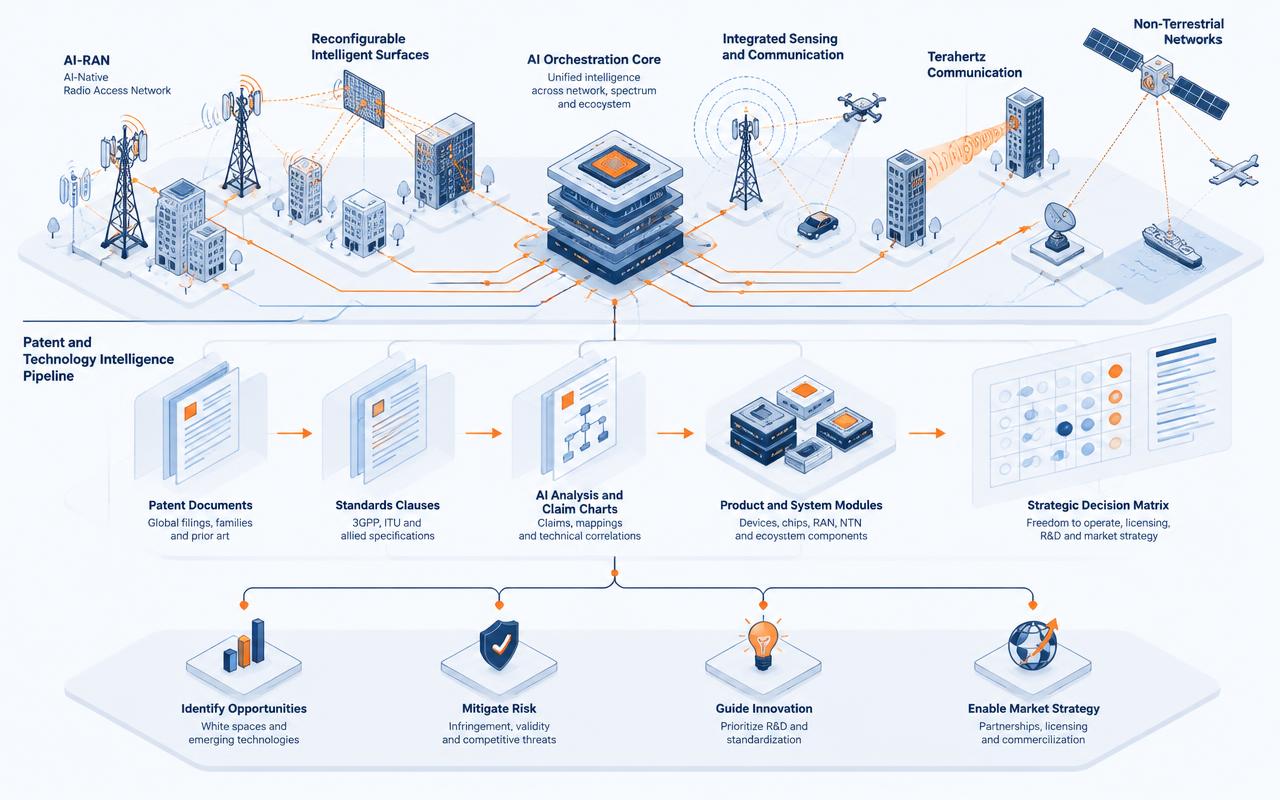
The commercial 6G question is no longer simply which radio techniques may increase capacity. Future networks are being shaped around intelligence embedded throughout the system: models that influence scheduling, mobility, beam management, orchestration, anomaly response, energy use, sensing and application exposure. That changes the patent landscape. Value may sit not only in a model or radio algorithm, but in the data pipeline, training arrangement, control-loop timing, distributed inference architecture, hardware implementation, interface, security mechanism and system interaction that make the intelligence operational.
For IP leaders, this creates a connected battlefield. One product architecture may touch telecom protocols, semiconductor accelerators, cloud and edge orchestration, sensing, privacy, model lifecycle management and network security. A search that follows only the phrase ‘6G’ will miss earlier or differently drafted families. A standards-only review will miss proprietary implementation choices. A patent-only review may overstate relevance unless claims are tested against technical evidence. Decision-grade intelligence must connect all three.
The AI-Native 6G Technology Stack Is Also an IP Stack
The first analytical task is to decompose the system into mechanisms rather than buzzwords. ‘AI-native’ can describe very different inventions: an AI-assisted optimisation outside the critical path, a learned receiver replacing a defined signal-processing block, a distributed model coordinating radio resources, or a network architecture in which model deployment and inference are managed as native services. Each creates different search concepts, evidence needs, claim themes and implementation risks.
- 01AI-RAN: learned air interface, scheduling, beam and mobility control
- 02AI-enabled core: policy, analytics, exposure and autonomous orchestration
- 03Edge AI: model placement, distributed inference and federated learning
- 04Integrated sensing and communication: waveform, processing and fusion
- 05Sub-THz / terahertz: channels, front ends, beam control and packaging
- 06Reconfigurable intelligent surfaces: control, estimation and coordination
- 07NTN integration: satellite, aerial and terrestrial continuity
- 08Trust layer: data provenance, model security, privacy and explainability
| Layer | Patent focus | Decision enabled |
|---|---|---|
| AI-RAN | Learned receivers, channel estimation, scheduling, beamforming, mobility and RAN control | Prioritise radio R&D, standards monitoring and implementation review |
| AI core and orchestration | Data analytics, policy, model lifecycle, intent, compute-aware control and exposure | Map platform leverage and cross-domain dependencies |
| Edge and distributed AI | Inference placement, split learning, federated learning, model transfer and resource coordination | Assess cloud, device, chipset and operator positions |
| ISAC | Joint waveform, sensing reference signals, fusion, localisation and sensing-data control | Separate standards-facing mechanisms from product-specific sensing |
| Sub-THz / THz | RF architecture, antennas, channels, beam tracking, materials and semiconductor implementation | Connect radio concepts to component and manufacturing rights |
| RIS | Surface elements, control protocols, channel estimation and network coordination | Identify ownership across equipment, materials and network actors |
| NTN | Mobility, timing, beam and spectrum coordination across satellite and terrestrial access | Track convergence risk and partnership dependencies |
| AI trust | Training data, model integrity, adversarial defence, explainability and privacy | Prioritise governance and security architecture before deployment |
The taxonomy should be narrowed to the target product, portfolio or transaction. Inclusion in a layer does not establish patent quality, essentiality or infringement.
One Connected IP Battlefield, Not Separate Technology Silos
AI-native 6G combines rights from organisations that may never appear in the same conventional competitor list. Network vendors and operators interact with chipset developers, cloud platforms, model and software providers, satellite companies, RF component suppliers, sensing specialists, universities and research institutes. Rights may originate in one layer and gain leverage in another. A model-compression technique can become commercially relevant because it enables edge inference under radio and energy constraints; a packaging invention can affect a sub-THz front end; a data-governance mechanism can determine whether distributed learning is deployable across jurisdictions.
NETWORK AI-RAN · core · NTN
COMPUTE edge · cloud · accelerators
SENSING & RF ISAC · THz · RIS
EVIDENCE patents · standards · products
RIGHTS claims · ownership · jurisdictions
DECISIONS file · clear · partner · monitor
= High-quality, enforceable patent draft
AI-Assisted Patent Intelligence Needs Human Evidence Control
AI can accelerate multilingual concept expansion, semantic retrieval, family clustering, claim-theme coding, standards-document triage and change detection. It can also create convincing but unsupported associations. A robust workflow uses AI to increase coverage and consistency while preserving reproducible queries, source citations, family logic and expert review. Every material relationship should be traceable from the decision back to the claim, standards passage, product source or ownership record on which it depends.
- 01Frame the business decision and technical boundary
- 02Build a mechanism-led taxonomy and synonym architecture
- 03Retrieve patent, standards and technical evidence
- 04Consolidate families, ownership, status and jurisdiction
- 05Use AI to cluster themes and surface candidate relationships
- 06Review claims and evidence with telecom and patent specialists
- 07Grade confidence, gaps and assumptions
- 08Translate findings into monitored and owned actions
The output should distinguish direct evidence, supported inference and an open question. This matters especially in 6G, where terminology changes quickly and the same phrase can appear in research, a patent specification, a standards contribution and marketing material with different meanings. Human review is not a ceremonial final check; it determines whether the machine-found relationship is technically coherent and commercially material.
What a Decision-Grade 6G Patent Landscape Reveals
A landscape becomes useful when it explains claim direction, portfolio structure and technical adjacency. Family consolidation prevents continuation strategies and multinational filings from being mistaken for independent inventions. Ownership review identifies assignments and collaborations. Legal-status and jurisdiction filters align the dataset with actual manufacturing and sales exposure. Claim coding shows whether protection is directed to architecture, method, model lifecycle, signal processing, hardware, interface, security or a cross-layer combination.
Questions the landscape should answer
- Which live claim themes align with the product or research roadmap?
- Where do selected organisations appear to be building adjacent, complementary or overlapping positions?
- Which technical intersections are active but not yet well covered by the reviewed claim set?
- Where do continuations, pending applications or standards activity warrant monitoring?
- Which jurisdictions matter to deployment, manufacturing, import, cloud operation or licensing strategy?
- Which candidate families require deeper claim review rather than automated categorisation?
- Where could partnerships or acquisitions provide capability that internal filing alone cannot deliver quickly?
Company Intelligence Should Be a Watchlist, Not a Leaderboard
A defensible ecosystem view begins with roles and evidence. Depending on scope, a watchlist may include radio and core-network vendors, operators, semiconductor companies, hyperscalers, satellite and aerospace companies, device makers, sensing and RF specialists, AI infrastructure providers, universities and public research organisations. Their inclusion means public evidence makes them relevant to the defined question. It does not rank them, establish technical leadership or imply that their patents are essential, valid or infringed.
| Organisation type | Signals to monitor | Strategic use |
|---|---|---|
| Network vendor / operator | RAN and core research, contributions, trials, patent families and partnerships | Track architecture direction and standards-facing positions |
| Semiconductor / RF supplier | Accelerators, transceivers, antennas, packaging and edge-compute implementations | Connect system concepts to enabling hardware |
| Cloud / AI platform | Model lifecycle, orchestration, distributed inference and network APIs | Map control points beyond traditional telecom portfolios |
| Satellite / aerial platform | NTN access, routing, mobility, spectrum and payload intelligence | Assess terrestrial–non-terrestrial convergence |
| Research organisation | Early publications, collaborative filings and technical proposals | Identify emerging mechanisms and transfer pathways |
Company-level conclusions require a defined search date, dataset, family rules and evidence trail. This framework intentionally provides no unsupported ranking.
Standards, SEPs and the Evidence Chain
A standards declaration, contribution, patent family and product are connected only through evidence. ITU-R recommendations and reports support the IMT-2030 framework. 3GPP study items explore feasibility and architecture; work items can lead to normative specifications. ETSI maintains relevant standards activities and declaration infrastructure. None of those roles makes every 6G-related patent a standard-essential patent. Potential essentiality depends on whether a live claim, properly construed, may be necessary to implement a mandatory requirement of an applicable specification.
- 01Identify the applicable specification version
- 02Locate a mandatory technical requirement
- 03Select a live patent family and jurisdiction
- 04Break the relevant claim into limitations
- 05Map each limitation to precise specification language
- 06Record support, ambiguity and missing elements
- 07Apply expert technical and legal review
- 08Express a qualified essentiality view — not an automated verdict
Explore SEP Claim Charting
Build a limitation-level evidence trail between patent claims and the precise technical requirements that matter.
Explore SEP Claim ChartingClaim Charts Turn Thematic Matches into Reviewable Evidence
Titles, abstracts and classifications are useful for discovery, but they do not establish claim coverage. A claim chart decomposes an independent claim into limitations and maps each limitation to a specification passage, implementation feature or product evidence source. It also records what is absent, ambiguous or dependent on interpretation. In an emerging 6G context, version control is essential: the relevant wording can change between research proposals, study conclusions, work items and later normative text.
| Claim element | Evidence target | Analytical status |
|---|---|---|
| Collect network-state and radio observations | Defined input data and measurement sources | Supported only where the evidence identifies the required inputs |
| Apply a trained model to produce a control output | Model function, placement and inference step | Needs more than a general statement that AI is used |
| Coordinate radio and compute resources | Joint scheduling or orchestration mechanism | Requires evidence for both resource domains and their relationship |
| Update operation using feedback | Closed-loop timing, feedback and adaptation | Open if the source shows only offline optimisation |
This is an analytical template, not a chart of any actual patent or a conclusion on essentiality, infringement or validity.
Patent-to-Product Mapping Connects Rights to Commercial Exposure
The business value of a family depends partly on whether its claimed mechanism can be connected to an implementation that matters. For 6G, public evidence may include specifications, technical papers, trial descriptions, chipset documentation, network architecture material, software documentation, teardown results and partner announcements. Each source has limits. Model internals, training data, process details and network configurations may remain unobservable and should be labelled as evidence gaps rather than inferred as fact.
- 01LIVE CLAIM
- 02TECHNICAL MECHANISM
- 03STANDARD OR IMPLEMENTATION EVIDENCE
- 04NETWORK / CHIP / DEVICE / SERVICE
- 05JURISDICTION AND COMMERCIAL CONTEXT
- 06PRIORITISED REVIEW ACTION
A useful mapping grades potential relevance. A priority-review family may align with reliable evidence across material limitations and an important jurisdiction. An evidence-gap family may appear relevant but depend on an unobservable feature. A monitor family may have a developing continuation or uncertain future product connection. These are diligence categories. They are not infringement opinions and do not replace counsel-led claim construction, validity analysis or product discovery.
Potential Whitespace Exists at Technical Intersections
AI-native 6G opportunity is often found between established domains: model lifecycle and mobility; sensing data and privacy; RIS control and channel prediction; NTN handover and distributed inference; sub-THz beam control and hardware constraints; or energy objectives and multi-resource orchestration. A simple density heat map can miss these intersections because relevant claims use different vocabularies and classifications. Conversely, an apparently sparse area may reflect immature publication, trade-secret practice or a weak search strategy rather than genuine whitespace.
- 01Define the 6G performance or deployment constraint
- 02Decompose the mechanism and viable alternatives
- 03Map live claim themes across adjacent domains
- 04Identify weakly covered combinations
- 05Test terminology, classifications and non-patent literature
- 06Review engineering feasibility and commercial timing
- 07Validate novelty and inventive step separately
- 08Convert supported opportunities into R&D and filing priorities
Whitespace is therefore a hypothesis requiring validation. It does not guarantee novelty, inventive step, patentability, freedom to operate or commercial success. The strongest output is a short list of technically plausible opportunities linked to engineering problems, adjacent rights and a defined validation plan — not a decorative empty zone on a chart.
Validate emerging 6G opportunities
- Patent search services
Build a mechanism-led evidence set across patents and adjacent terminology.
- Novelty search
Test a proposed technical contribution before committing to drafting.
- Patent analytics
Connect portfolio, ownership, technology and competitive signals.
FTO for 6G Must Follow the Actual Product and Jurisdictions
A broad 6G landscape is not a freedom-to-operate opinion. FTO begins with a defined implementation, relevant claims and the countries in which activities may occur. For an AI-native network product, that may require separating device, base-station, chipset, cloud, edge, model-training and service-operation features. Manufacturing, import, sale, use and hosted operation can create different jurisdictional questions. Supplier agreements and open-source or model licences may also influence the risk picture alongside patents.
Stage clearance before choices become expensive
- Use landscape intelligence while architecture alternatives remain open.
- Run focused claim screening when radio, model, compute and interface choices stabilise.
- Prioritise live rights in relevant manufacturing, deployment and sales jurisdictions.
- Document product evidence and unresolved technical assumptions.
- Investigate design alternatives, licences, acquisitions or supplier allocation where warranted.
- Escalate selected families for counsel-led legal review before launch or major commitment.
Assess 6G IP Risk
Scope a product-specific review across the implementation, supply chain and commercial jurisdictions that matter.
Assess 6G IP RiskMonitor the Ecosystem as Evidence Changes
6G intelligence cannot be treated as a one-time report. Patent families publish and change ownership. Claims are amended. Research moves into studies, work items and specifications. Trials expose implementation detail. Products and partnerships clarify which technical options are becoming commercially credible. A monitoring programme should define events, thresholds and owners so that change produces action rather than another alert inbox.
Monitor
- New families and continuations
- Assignments and transactions
- 3GPP, ITU-R and ETSI developments
- Trials, products and partnerships
Interpret
- Claim-scope change
- Technology convergence
- Evidence confidence
- Jurisdiction and timing
Act
- File or continue
- Clear or design around
- Partner or acquire
- Prepare standards and licensing strategy
Geographic Activity Must Be Read as Strategy, Not a Scoreboard
A geographic view can show where applicants seek protection, where research collaborations originate and where manufacturing or deployment exposure may arise. It should not turn application volume into a national innovation ranking. Filing behaviour is influenced by portfolio budgets, prosecution systems, market access, continuation practice, subsidies, publication timing and corporate structure. The useful question is whether jurisdiction coverage aligns with the supply chain, standards participation, product roadmap and enforcement or licensing objectives relevant to the engagement.
The AI-Native 6G IP Value Chain
Different decisions require different evidence depth. Early research teams need taxonomy, prior-art and whitespace views. Portfolio leaders need claim coverage, family strategy and filing priorities. Standards and licensing teams need specification-version control and claim charts. Product counsel needs implementation evidence and jurisdiction-filtered FTO triage. Corporate strategy teams may need partner, acquisition or portfolio-diligence analysis. A connected programme lets each team work from a consistent evidence base without pretending that one output answers every question.
- 01TECHNOLOGY SCOUTING
- 02PATENT LANDSCAPE
- 03WHITESPACE VALIDATION
- 04PORTFOLIO DESIGN
- 05STANDARDS & SEP ANALYSIS
- 06PATENT-TO-PRODUCT MAPPING
- 07FTO & RISK RESPONSE
- 08LICENSING, PARTNERSHIP & MARKET STRATEGY
How Hashi Supports AI-Native 6G Decisions
Hashi structures the work around the decision, technical boundary and evidence state. Telecom and patent specialists build mechanism-led taxonomies, retrieve and validate families, review claims, distinguish standards stages, and connect selected rights to technical and commercial evidence. AI supports coverage and consistency; expert review governs relevance and conclusions. Deliverables are designed for R&D, product, IP, standards, licensing and strategy teams to use together.
| Module | Core question | Typical output |
|---|---|---|
| 6G patent landscape | Where are relevant live rights and claim themes developing? | Taxonomy, family dataset, claim clusters and jurisdiction views |
| Competitive watchlist | How are selected organisations building positions across the stack? | Evidence-led company–technology matrix and monitored signals |
| Standards intelligence | How is a technical concept moving through formal activity? | Study, work-item, specification and contribution evidence map |
| SEP and claim charts | Do selected claims potentially map to mandatory requirements? | Limitation-level charts with qualified technical review |
| Patent-to-product mapping | Which rights may be relevant to observable implementations? | Evidence citations, gaps and priority categories |
| Whitespace and filing | Which intersections merit deeper invention review? | Opportunity hypotheses, prior-art plan and filing priorities |
| FTO / IP risk | Which rights require product-specific legal attention? | Jurisdiction-filtered triage and counsel-ready evidence |
| Portfolio strategy | What should be filed, continued, acquired, partnered or monitored? | Action roadmap aligned with technology milestones |
Related 6G, standards and IP intelligence
- 6G core network functions
Explore emerging AI-native control, analytics, orchestration and exposure functions.
- 3GPP intelligence services
Connect standards activity, patents, claims and technology roadmaps.
- Non-terrestrial network SEPs
Review NTN standards, declarations and claim-level evidence.
- SEP analysis
Prioritise standards-facing portfolios without treating declarations as proof.
- Standards mapping
Map claim limitations to precise technical requirements.
- Telecommunications industry
See Hashi's telecom patent and standards capabilities.
- Semiconductor industry
Connect 6G systems to RF, accelerator and edge hardware IP.
AI-native 6G patent landscape FAQs
It is a structured analysis of patent families and claims across AI-RAN, AI-enabled core functions, edge intelligence, sensing, sub-THz or terahertz systems, intelligent surfaces, NTN and trust mechanisms. It connects those rights to standards status, ownership, jurisdiction, product evidence and business decisions rather than reporting an undifferentiated patent count.
Is Your 6G Innovation Ready for the IP Race?
Hashi IP Solutions combines AI-powered IP intelligence with human patent and technology expertise to help companies discover, analyse, map and strategically protect emerging 6G technologies. Tell us the technology area and the decision you need to make. Please do not share confidential invention details in this initial enquiry.
Build Your AI-Native 6G IP Strategy
Share the 6G domain and business question. We will suggest a focused intelligence path without requesting confidential invention details.